Showing posts with label gardening. Show all posts

Subtropical Backyard 2014

kentia palm and silver fern
Kentia Palm on the left, with a Silver Fern in the foreground

cooperi tree ferns
The sloping site is good for drainage,
Cooperi tree ferns and birds nest ferns

Cabbage Tree Palms
Native grasses and Cabbage Tree Palms

cooperi and dicksonia tree ferns
Tree Ferns three years old
cooperi and dicksonia

Tree Ferns in Merewether NSW

Handmade Spotlight Stallholders

Growing Books
Growing Books is an inspirational concept
Growing Books Stallholder and Markets
Recycling Hardcover books and sharing succulent cuttings - viola!

HERE is an edited excerpt of an article on Growing Books, a niche stallholder at the markets, you can read more at findhandmade.com.au

Nestled in the shade of a Port Jackson fig, there’s a couple of paint dappled ladders with rows of aged hardcover books, tied up by twine, with little succulents peeking out – and a couple of lads sitting calmly behind. 

You can see Jeremy and Luke seated at rear, one rubbing his beard the other tilting a sideways glance from behind his dark sunglasses. 

A chalkboard sets the price and some social media details – as though the product speaks for itself – pairs or trios of books with a cutting from a succulent in a little pot cut into the book. As though the book is holding a little handful of nature.

It’s a curious concept – combining the architectural structure of succulents with the history and gravity of a yellowing old tome – the lasting resilience of the cactus with the fleeting moment of the written word.  

But it works – there is a stream of passers by stopping and pointing like an eddy in the current – some simply staring at the rows of books and the chunky cute cuttings poking proudly out.

This is Growing Books and this is upcycling and recycling and repurposing across genres – taking ancient tomes and bending them into plant pots – completely not what was intended and with a eyebrow raising quirkiness that really captures the zietgiest of handmade in 2014.

Brian Larkin Pullets 12 wks Old

Six Layer Pullets just finding their feet in the new chookhouse
Here are the new chickens - three white pullets 12 weeks old and three older birds 20wks.  The buff bird at the front looks a little scraggily as she is moulting.  They had just been released into the chicken pen and were finding their feet.

12 week pullets from Brian Larkin, Tahmoor, NSW, Australia.
As you can see they began to scratch and peck immediately and sorted through the kitchen scraps we had out for them.

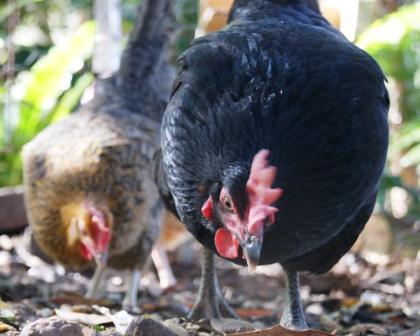
image of Black Australorp from Brian Larkin, Tahmoor.
There is a black bird - apparently a cross with an Australrop - I have had these types previously and they make great layers.  Also, note the beetle green sheen on the black feathers - it is very striking in the morning light.

image of a hybrid chicken from Brian Larkin
This bird was described as Grey by Brian Larkin - it has an almost tortoise-shell pattern and it will probably work well for camouflage from predators etc when it is free ranging.  
It is always exciting introducing new Birds into the flock.  Met with Brian Larkin this morning and recruited another half dozen of his birds into my flock.  Let's hope they have long and prosperous lives helping work the rainforest and are happy and productive on the egg front too!

Asked to take some images of the birds in the transport truck but was declined, as he feared they might be repercussions as people see the transport as inhumane for some reason.  I could not see why or how the conditions were not acceptable - it is tricky work moving a couple hundred chickens across the state. 

Anyway, lovely bloke and hope I don't have to buy any more for a while and the dog stays away from the girls and lets us all live in peace.

Brian Larkin Recommends


It is always advisable:

1) To run your flock of young pullets away from older birds at least until fully mature to help avoid picking up other established diseases that your older birds might have been exposed to and most likely have developed an immunity to.

2) Treat all new birds you add to your flock with a coccidiostat via the drinking water approx 10 days after bringing them home and make sure the new birds are fed on an appropriate ready mix feed, that also contains a coccidiostat until they are at least five to six months old.

Transplanting Cyathea Tree Ferns

Cyathea cooperi Tree Fern after being moved
 This is a five year old Cyathea cooperi Tree Fern which we transplanted from its original postion to this spot.

You can see how I dug down about 500mm for the rootball to be covered at ground level and then built up organic matter (cow manure and compost) around the base and trunk for stability and to keep the moisture in.  This is very effective in giving transplanted tree ferns the damp but not moist conditions they thrive in, plus it saves having to build stakes around the plant for structural support.

I used about fifteen rocks to keep the base firm and to protect it from foraging chickens, as well as about eight bricks to stop erosion from watering.  The rootball at 5 years is about the 500mm across, and I did chop it back a bit for shape with a spade to give the rootball as neat fit with the hole.

Using three 25L bags of cow manure and about 2 bags of compost means the plant has plenty of nutrient rich media to grow into as it settles into place.  I imagine it will take 18 months to settle in completely and re establish the fronds to the previous length, which was about 3m long and about 15 fronds.


The Biggest Mistake I made Gardening

Way back in the early 1990's when I was doing my first gardens (unpaid works on houses my parents had bought with big stretches of green grass and nothing much else)I had huge plans and grand bvisions of European inspired layouts with monster ancient trees romantic stands of silver birch.

So I went out and ordered the European trees and staked out a rough plan for the planting and when they were delivered set about plating them out. Which was all fine and with copious water made for a great start for the saplings.

Only thing was, I didn't count on the searing Australian heat, nor did I plan for the planting by taking into account the aspect of the planting. So the silver birch were sitting high facing torrid western sun and the blowing hot winds of late summer, which stripped them bare of their delicate leaves. And the slow to establish Oak just sat morosely in it's spot and basically entered a hibernation prior to quietly dying a season or so later.

That's when I learned to snap of a twig of a deciduous tree and to see if it is green on the inside just to check that it is still alive. But they were valuable lessons learned.

Gardening Ideas Australia

Australian Garden Ideas
View of the Backyard 2011
Hi, and welcome to my blog featuring Australian Gardening Ideas, Designs and Plant Ideas for sustainable and organic gardening in the suburban setting.  I'm trying to be organic and sustainable, but sometimes it just isn't practical, but I like to keep those concepts in mind. 

First, let me introduce myself; I live in Merewether, Newcastle, Australia, on a large block backing onto bush reserve.  I have spent the past three years clearing the weeds from the backyard and am in the process of re-planting the space with Australian Native Plants.  Gourmet Hampers Australia. In that time I have learned a lot about patience and timing but thankfully the drought has ended and I am enjoying the period of sustainable growth without excessive watering.

My next plan is to add a chicken coop and enjoy fresh eggs and intense organic fertiliser.  Keep coming back and I'll let you share in the journey...