Showing posts with label rainforest. Show all posts

Tree ferns in Spring

fronds of the rough tree fern in backyard setting
 Here is a Cyathea australis from 15 months ago and how it has established itself in a fairly shady section of the garden.
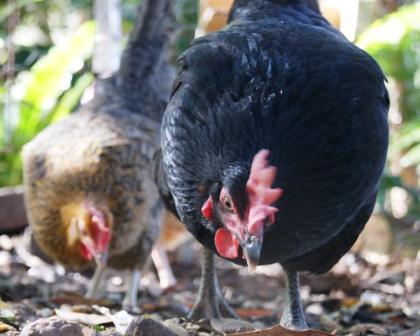
The chickens are completely at home in the dense undergrowth - they huddle like this when they are scared - I have only had these birds for a few months and have not handled them so they are virtually wild except for when they return to the chicken coop each sunset.
 Here is an example of how I have built up the base of the citrus so the organic compost and cow manure stays in place despite the attention of the chickens and erosion from rain and watering.  I place the manure underneath bricks and pavers and then back fill the gaps with broken sticks and branches so there is no exposed earth for the chickens to dig up or water to wash away.

Even here you can see how over time the mound around each citrus has built up providing valuable organic matter that is well drained.

Brian Larkin Pullets 12 wks Old

Six Layer Pullets just finding their feet in the new chookhouse
Here are the new chickens - three white pullets 12 weeks old and three older birds 20wks.  The buff bird at the front looks a little scraggily as she is moulting.  They had just been released into the chicken pen and were finding their feet.

12 week pullets from Brian Larkin, Tahmoor, NSW, Australia.
As you can see they began to scratch and peck immediately and sorted through the kitchen scraps we had out for them.

image of Black Australorp from Brian Larkin, Tahmoor.
There is a black bird - apparently a cross with an Australrop - I have had these types previously and they make great layers.  Also, note the beetle green sheen on the black feathers - it is very striking in the morning light.

image of a hybrid chicken from Brian Larkin
This bird was described as Grey by Brian Larkin - it has an almost tortoise-shell pattern and it will probably work well for camouflage from predators etc when it is free ranging.  
It is always exciting introducing new Birds into the flock.  Met with Brian Larkin this morning and recruited another half dozen of his birds into my flock.  Let's hope they have long and prosperous lives helping work the rainforest and are happy and productive on the egg front too!

Asked to take some images of the birds in the transport truck but was declined, as he feared they might be repercussions as people see the transport as inhumane for some reason.  I could not see why or how the conditions were not acceptable - it is tricky work moving a couple hundred chickens across the state. 

Anyway, lovely bloke and hope I don't have to buy any more for a while and the dog stays away from the girls and lets us all live in peace.

Brian Larkin Recommends


It is always advisable:

1) To run your flock of young pullets away from older birds at least until fully mature to help avoid picking up other established diseases that your older birds might have been exposed to and most likely have developed an immunity to.

2) Treat all new birds you add to your flock with a coccidiostat via the drinking water approx 10 days after bringing them home and make sure the new birds are fed on an appropriate ready mix feed, that also contains a coccidiostat until they are at least five to six months old.

Transplanting Cyathea cooperi

 Now the Cyathea cooperi has been in place in its' new position for about ten weeks, you can see that it has recovered from the shock of the move and is growing new fronds.  The three old fronds have slowly withered and the nutrients have moved back into the plant. 

I have not watered it by hand since I moved it, except for a long soaking on the day of the move.  Relying on rainfall and the milder climate over winter, it has re-shot a brace of three fronds and although they are thinner and won't be nearly as big as the previous fronds just yet, it is well on its' way to getting established.

 Just included a shot here of a friendly daughter to add some perspective - you can see how the trunk stands about 500mm emergent above the soil line, and remember there is at least that much in the potting mix around the base.

Here's hoping it keeps going on strong and is robust enough to survive the heat and wind of summer.


 This is a Cyathea planted at the same time as the transplanted one, and demonstrates clearly that tree ferns thrive once established and not disturbed. It is not my usual practice to lift and move plants around the garden for exactly this reason.


Here are some landscape shots of the garden as a whole - it is coming along nicely even though I have left it without any extra watering since February.  I like to let the soil dry out over winter.  I did go this morning and water for a good hour though, as without water everything grows very slowly.  And the winds of August dry things out even more.


And finally, introducing some of the newest members of the flock - some silver lace wyandottes bought from a lovely lady at the Maitland Wyandotte Show 2013.  At three and a half months, they might be a little vulnerable to the rest of the flock but I am offering them protection for a couple of weeks.  Just love that colour!


Transplanting Cyathea Tree Ferns

Cyathea cooperi Tree Fern after being moved
 This is a five year old Cyathea cooperi Tree Fern which we transplanted from its original postion to this spot.

You can see how I dug down about 500mm for the rootball to be covered at ground level and then built up organic matter (cow manure and compost) around the base and trunk for stability and to keep the moisture in.  This is very effective in giving transplanted tree ferns the damp but not moist conditions they thrive in, plus it saves having to build stakes around the plant for structural support.

I used about fifteen rocks to keep the base firm and to protect it from foraging chickens, as well as about eight bricks to stop erosion from watering.  The rootball at 5 years is about the 500mm across, and I did chop it back a bit for shape with a spade to give the rootball as neat fit with the hole.

Using three 25L bags of cow manure and about 2 bags of compost means the plant has plenty of nutrient rich media to grow into as it settles into place.  I imagine it will take 18 months to settle in completely and re establish the fronds to the previous length, which was about 3m long and about 15 fronds.


Garden Plants at the Markets

The Value Of Markets Directory

At The Australian Markets Directory, we have collected the attention of a vast group of people with similar interests, beliefs and experiences – that being Local Markets.  And as a focal point for these many businesses, markets organisers and enthusiasts, we are able to offer a unique selling proposition – having the industry as a whole at your fingertips.

Now we have the attention and focus of the Australian Markets Community, it is important to channel that value into the best proposition for new and existing member of the directory.  And we do this by offering a direct connection between your individual concern and the wider markets community. 

After we have assessed your application and where applicable, edited your submission to meet our strict quality control guidelines, you will be granted a listing in the directory.  This opens up great opportunities for your brand and with the consistent online promotion of the Directory, increased exposure to traffic and potential business arrangements.

It is critical that whislt we value so highly the attention and participation of the markets community, we do not go too far with cross promotion or advertising of content that is not directly related to the specific niche.  So you won’t see ads for locksmith North Carolina or Real Estate Vancouver.  Just real world listings of local real world business and markets and stallholders.

Australian Summer Heat and Humidity

Noxious Weeds for Removal
After the heatwave the garden has suffered with burnt fern fronds and drooping palms.  It was a pleasure to finally have to water the garden after such a long time relying wholly on rainfall.  We have been busy installing a recycled industrial staircase in the garden so we have easier access to the deep backyard.

But it is a pleasure to hear the dripping rain and watch from our back verandah.